
How to use alias for using-directives and namespaces in C#
Anyone who has already written one or the other program in Visual Studio with C# probably knows the following problem. Sometimes you use different libraries (Dlls) from different developers/vendors. Partly also libraries that fulfill similar purposes. This might go well, but it doesn’t have to.
Often you will get confronted with an error message like this: “‘XYZ’ is an ambiguous reference between ‘LibraryA.XYZ’ and ‘LibraryB.XYZ’”
What next? In the following I’ll explain how to solve this kind of error by taking the example of the AForge library. For instance we profess that we included the following using-directives into our program.
using System.Drawing;
using AForge.Imaging;
So now, if we use the class “Image” in our program, we will see the following error message, which result from the fact that there are two “Image” classes referenced. One in the System.Drawing namespace as also one in the AForge.Drawing namespace. Visual Studio (and later on it’s compiler) doesn’t know which Image class to […]
 The .NET framework provides a large number of ways to encode HTML code and URLs. There exist, for example, Uri.EscapeDataString(), Uri.EscapeUriString(), System.Web.HttpUtility.UrlEncode(), System.Web.HttpUtility.UrlPathEncode(), System.Web.HttpUtility.HtmlEncode() or System.Web.HttpUtility.HtmlAttributeEncode().
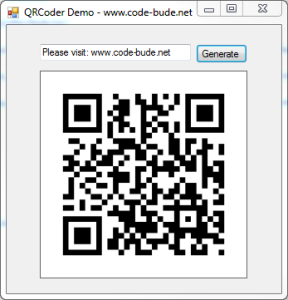 In modern times QR codes should be known by pretty much everyone. Since smartphones are becoming increasingly popular, QR codes can also be found at more and more places in our everyday lives. As a fairly serious geek this should be reason enough to engage a bit more in detail with the technology behind it. And what way seems to be more suitable than implementing a QR code generator by yourself?
 With the .NET frameworks DateTime functions you can do a lot of nice things. The handling turns out, in my opinion, very pleasant. The only requirement: You find yourself in a pure .NET environment. When other systems come into play, the trouble begins. But why is it that you can not compare DateTime.Ticks with the PHP mktime()-function?
 Today I want to show you how to perform a XML serialization in C#. Serialization itself, means that you convert an object to another, transportable form.